How Accurate Is a Phone GPS Speedometer?
A phone GPS speedometer can be useful for live movement speed, but accuracy depends on signal conditions, device hardware, and how often the browser receives fresh location updates.
The short answer: accuracy depends on the test
A phone GPS speedometer can give a useful ground-speed estimate during steady outdoor movement, but no single error figure applies to every phone and trip. Receiver design, satellite geometry, sky visibility, permission precision, update timing and filtering all affect the result. Treat a universal claim such as “always within one unit” as incomplete unless it names the device, conditions, reference instrument and test method.
Position accuracy and speed accuracy are different measurements
The accuracy value reported in metres estimates uncertainty around the current position; it is not a guaranteed speed error. A location system may expose a direct speed estimate, while a web tool can fall back to distance over elapsed time when that value is unavailable. At walking pace, a few metres of position noise can be larger than the real distance travelled between updates, so an apparently precise coordinate does not automatically make every instant-speed digit reliable.
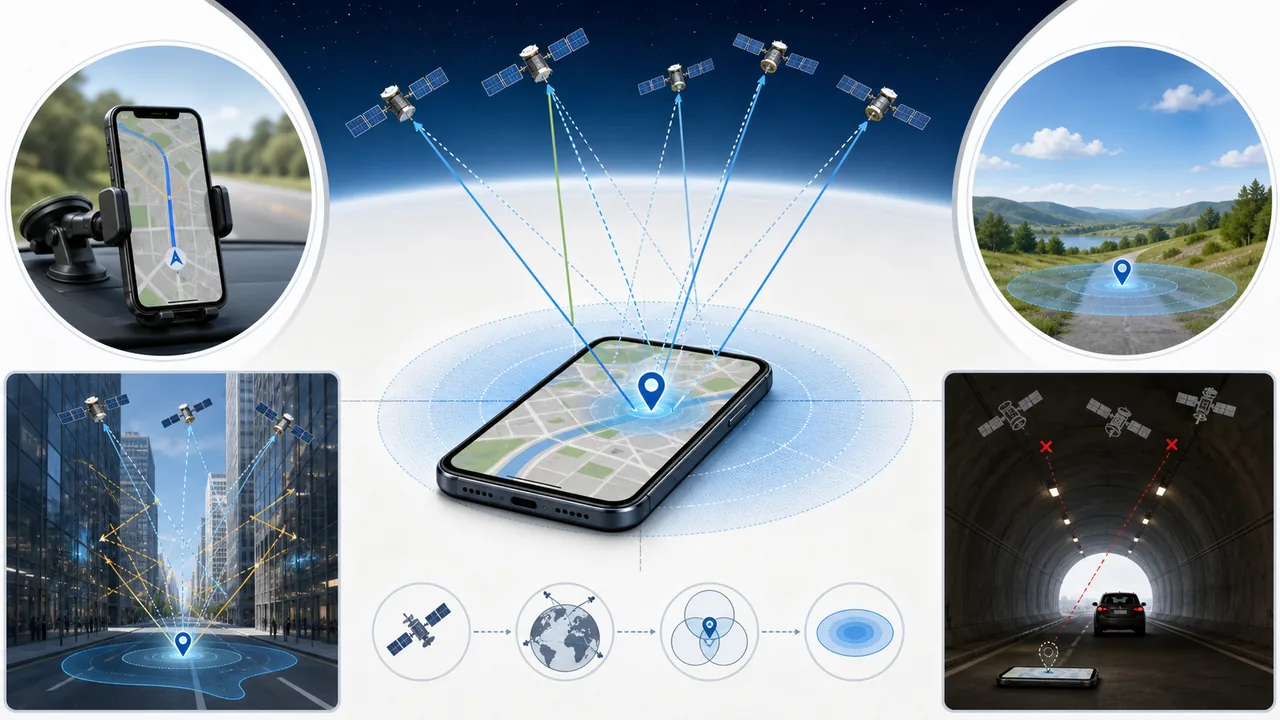
Hardware, placement and surroundings change the result
Phone antenna and receiver quality matter, as do approximate versus precise permission, placement near a window, coated glass, tree cover, tall buildings, cuttings and tunnels. More decimal places do not improve the underlying observation, and a faster mobile-data connection cannot restore blocked satellite signals. A fresh start or a recently recovered fix also needs time before its pattern is as useful as a settled open-sky segment.
Read the session, not one attractive number
Judge current speed together with fix freshness, the position-accuracy estimate, signal state and the recent chart. A repeatable plateau is more credible than a single maximum immediately after signal loss. During acceleration or braking, browser update intervals and smoothing can create visible delay even when steady-speed performance is good. At very low speed, compare a longer interval rather than interpreting each changing digit.
Use a repeatable comparison protocol
Secure the phone with a clear sky view and let a passenger operate it. Start the devices together, wait for the fix to settle, then compare the same long, straight section at a steady legal speed. Record phone model, operating system, browser, unit, reported accuracy and environment. Exclude tunnel transitions, repeat the section, and report the range or consistent offset instead of selecting the most favourable instant.
Know when the phone is only a secondary reference
A browser speedometer supports trip context and informal comparisons; it is not calibrated test equipment, a certified vehicle instrument or legal evidence. If speed remains zero during real movement, freezes, or jumps repeatedly, solve permission, foreground and reception problems before debating accuracy. For work that needs traceable uncertainty or calibration, use an appropriate verified reference and a controlled procedure.
| Condition or factor | What it means |
|---|---|
| Receiver factor | Phone hardware and satellite geometry |
| Environment | Buildings, canopy, roof and coated glass |
| Motion | Low speed and rapid changes are harder to display smoothly |
| Software | Update interval, filtering and background restrictions |
Technical references: GPS.gov GPS accuracy; MDN coordinates speed.
Try a live reading
Common questions
Short answers for this guide.
Can a phone GPS speedometer be exact?
No GPS reading is perfect. It can be close in good conditions, but signal quality always matters.
Why does speed update slowly?
The browser may receive location fixes only every few seconds, especially with weak signal or battery saving.
Does Wi-Fi or mobile data measure speed?
No. zigmaty measures movement with GPS location data, not internet speed.
What GPS accuracy is good for a speedometer?
There is no single perfect number, but lower meter values and stable updates usually mean a more reliable reading.
Why is GPS speed sometimes lower than the car dashboard?
Dashboards can read slightly high, while GPS may smooth or lag when the signal changes.
Does 5G make GPS speed more accurate?
Not directly. Mobile data can help some location services, but GPS speed mainly depends on satellite signal, device hardware, and browser updates.
Why is walking speed less stable than car speed?
At low speeds, small GPS position errors become more visible, so walking pace and speed can jump more than vehicle speed.