Average speed calculator: total distance and time
Enter the total distance travelled and the time covering that same journey. The calculator returns average speed in km/h, mph and m/s, plus average minutes per kilometre. It does not track GPS, infer stops or predict traffic: you decide which distance and time belong in the calculation.
Match distance and time to the same journey
Choose km or mi and enter the complete travelled distance, not merely the straight line between endpoints. Fill hours, minutes and seconds, using 0 for unused components. The starting example is 100 km in 1 hour 30 minutes. Changing the distance selector reinterprets the number in that unit; it does not automatically convert the typed distance.
Convert the clock into hours before dividing
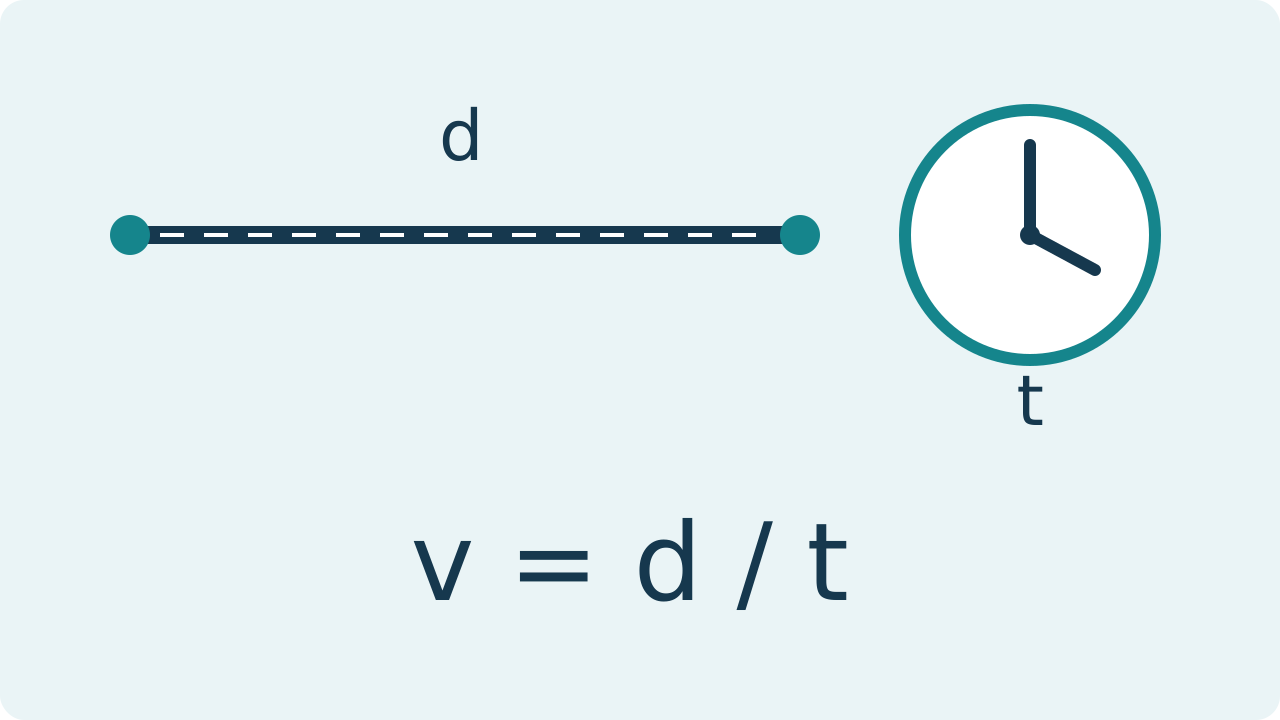
Average speed is total distance divided by total time. One hour 30 minutes is 1.5 hours, not 1.30 hours, so 100 ÷ 1.5 gives about 66.666667 km/h. The form performs this time conversion for you. Values above 59 minutes are accepted as a duration: 90 minutes and 1 hour 30 minutes produce the same result.
Decide whether waiting time belongs in the result
For a door-to-door average, include stops between departure and arrival. A 60 km journey with 1 hour moving and 30 minutes waiting averages 40 km/h overall, not 60. A moving-time average is a different question and needs a different duration. Label the result so another person knows whether breaks, crossings or loading time were excluded.
Do not simply average two speed readings
Covering 30 km at 30 km/h takes one hour; the same distance at 60 km/h takes half an hour. Total distance is 60 km in 1.5 hours, so the combined average is 40 km/h, not 45. A simple arithmetic mean works for equal durations, not generally for equal distances. Add all segment distances and times first.
Handle zero and missing values differently
Zero distance with positive duration gives zero average speed, while pace is undefined and shown as a dash. Zero total time cannot produce a valid speed and is rejected. An empty field is also not silently counted as zero. Negative inputs, unit text and grouped numbers are invalid. Extremely large values that overflow the calculation are rejected rather than presented as a finite answer.
Read average speed without inventing a maximum
An average does not reveal the highest speed, current speed or acceleration. An out-and-back trip has positive travelled distance even if its displacement is zero; this calculator uses distance, not vector velocity. The pace result is session-average minutes per kilometre, rounded to a whole second. For training splits or a planned finishing time, use the separate running-pace tool and its assumptions.
| Condition or factor | What it means |
|---|---|
| 100 km in 1 h 30 min | ≈ 66.67 km/h |
| 60 km in 1 h 30 min | 40 km/h |
| 30 km at 30, then 30 km at 60 km/h | 40 km/h overall, not 45 |
| 0 km with positive time | 0 speed; pace undefined |
Technical references: International mile conversion factors; Average speed and velocity.
Questions about average speed
Do stops count?
They count if included in the duration you enter. Use elapsed time for a whole-journey average.
Is 1 hour 30 minutes 1.30 hours?
No. It is 1.5 hours. Enter 1 in hours and 30 in minutes.
Can I enter miles?
Yes. Select mi before interpreting the distance value. Outputs still include both km/h and mph.
Does average speed equal average velocity?
Not necessarily. Speed uses travelled distance; average velocity uses displacement and direction.
Does this measure my maximum speed?
No. Total distance and time cannot determine a maximum or an instantaneous speed.