mph to km/h converter: miles per hour to kilometres per hour
Start with a speed in miles per hour and find its equivalent in kilometres per hour. This calculator multiplies by 1.609344, the exact kilometre length of the international mile. It is an arithmetic tool, not a speedometer or a lookup of local speed limits.
Confirm that the source really says mph
Use this direction for miles per hour, not knots or kilometres per hour. Enter the number only, using a point or comma for decimals. The example of 100 mph is provided to demonstrate the arithmetic, not to suggest a driving speed. If you have a distance in miles without an hourly rate, you have a different measurement.
Multiply while leaving the hour unchanged
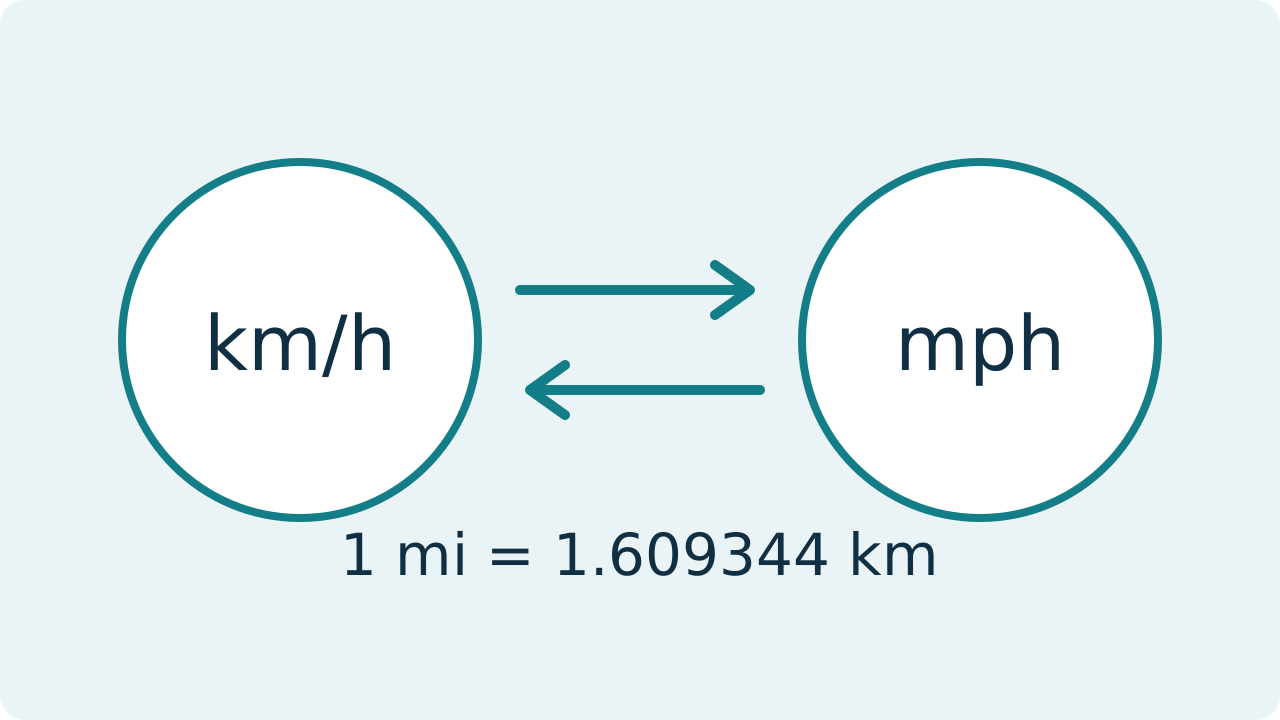
The formula is km/h = mph × 1.609344. Thus 60 mph becomes 96.56064 km/h, or 96.56 km/h to two decimals. No conversion of minutes is involved because both source and destination are per hour. Multiplying by 1.6 would give 96 km/h: close enough for a rough estimate but not the full result.
Recognise the size of common imperial readings
30 mph is approximately 48.28 km/h; 50 mph is about 80.47 km/h. A positive result must be numerically larger than its mph input. If it is smaller, the direction has likely been reversed. These are unit equivalences only, not a list of speed limits or evidence that a displayed speed is safe for the conditions.
Keep ordinary miles separate from nautical miles
The international mile used for mph is 1.609344 km, while the international nautical mile is 1.852 km. Nautical miles per hour are knots. A reading of 20 knots therefore cannot be entered as 20 mph without changing its meaning. Use the nautical converter when the original source says kn, kt or knots, and keep the source label when saving a result.
Interpret decimals and incomplete input honestly
The output shows at most six decimal places, using the selected page language. A blank or invalid entry gives a dash, not a valid-looking speed. Zero is allowed when entered explicitly. Rounding the calculation does not reduce uncertainty in a measured value; a phone or dashboard may already have rounded the original speed before you copied it.
Take the next step without losing context
The reverse link opens the separate km/h-to-mph page rather than changing only the URL. Record the original number, original unit and rounded result together. If your real question is how fast you are moving now, use the live mph instrument. If it is average speed over a trip, enter total distance and time in the average calculator instead of converting isolated peaks.
| Condition or factor | What it means |
|---|---|
| 20 mph | 32.18688 km/h |
| 30 mph | 48.28032 km/h |
| 50 mph | 80.4672 km/h |
| 60 mph | 96.56064 km/h |
| 70 mph | 112.65408 km/h |
Technical references: International mile conversion factors.
Questions about mph to km/h
How many km/h is 60 mph?
60 mph equals 96.56064 km/h before display rounding.
Is the factor 1.6 exact?
No. The full factor for the international mile is 1.609344.
Are mph and knots interchangeable?
No. They use different mile definitions; knots require the nautical conversion factor.
Why does a blank input show a dash?
An empty field is missing information, not a measured zero. Enter 0 when zero is intended.
Will the result show a legal road limit?
No. It only changes the unit of the number supplied.