GPS Speedometer vs Car Speedometer
A GPS speedometer and a car dashboard speedometer can both describe movement speed, but they measure it in different ways. Understanding the difference helps you read both with more confidence.
Quick answer: neither display wins in every condition
During steady movement under open sky, GPS can provide a useful estimate of true ground speed that is independent of tyre circumference. The vehicle display remains continuous in tunnels and normally responds promptly to wheel or drivetrain changes. A small stable difference can be normal; the useful question is which inputs, conditions and rules explain the pattern, not which number should always be trusted.
The two systems start from different inputs
A car speedometer generally converts wheel-speed, transmission or drivetrain information using expected tyre dimensions and vehicle calibration. A phone receives satellite-based location information and reports movement over the ground. GPS does not read the dashboard, OBD port or wheel sensors. The dashboard does not need a satellite view. Different inputs let both systems behave normally while showing different values.
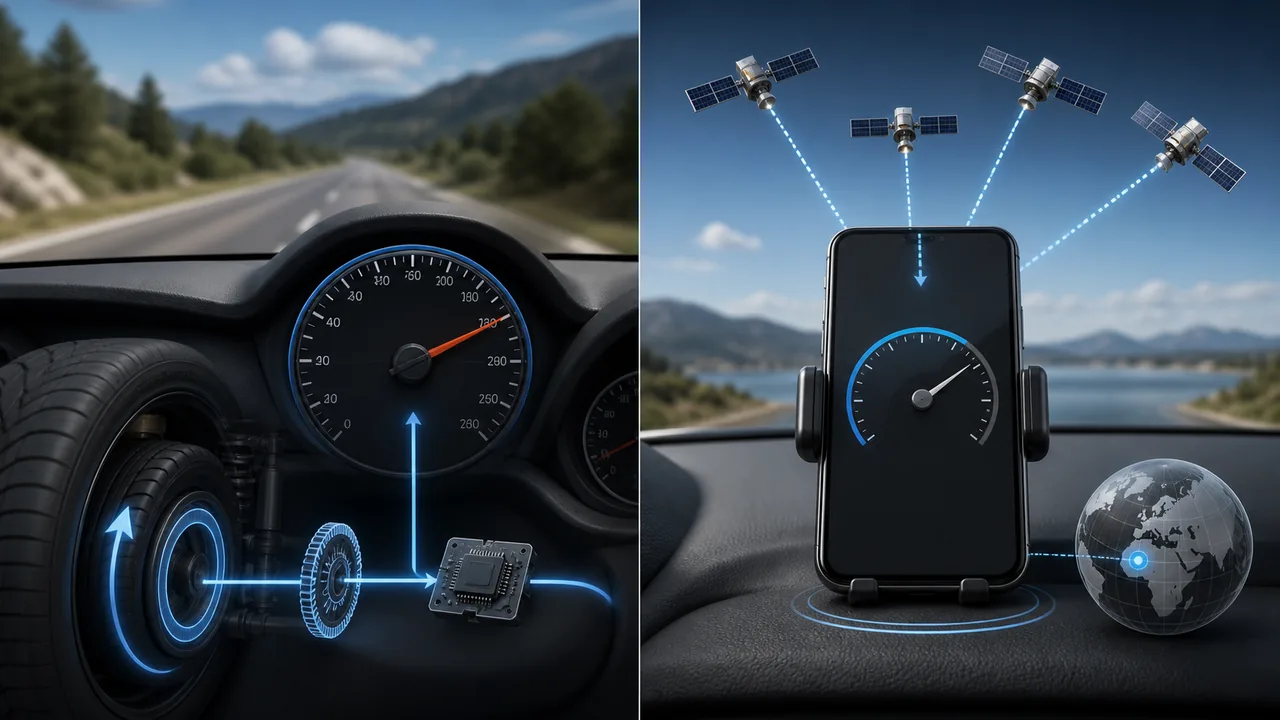
The size and pattern of the gap provide clues
Tyre size, tread wear, pressure, temperature, non-standard wheels and calibration can shift the dashboard relationship to actual road movement. A roughly consistent proportional or fixed offset at several steady speeds suggests a systematic difference; a phone value that jumps only beside buildings or after a tunnel suggests reception. One observation during acceleration cannot separate calibration from browser delay, so compare several stable plateaus.
Know when GPS loses its advantage
Tunnels, parking structures, deep cuttings, dense streets and some coated windscreens can delay or stop satellite updates. Rapid acceleration or braking can expose update-rate and smoothing lag. In those conditions, the vehicle display usually offers better continuity. After signal returns, ignore the first implausible peak and wait for several coherent updates before using the phone as a comparison reference.
Apply vehicle regulation within its actual scope
For vehicles covered by UNECE Regulation No. 39, the indicated speed at type approval must not be below true speed and the permitted positive difference follows a formula. That can explain dashboard over-reading, but it is not a universal percentage for every country, model, year or current vehicle condition. Check the regulation that applies to the vehicle rather than repeating a global rule of thumb.
Compare safely and act on an unusual difference
Use a straight open section, maintain a legal steady speed, secure the phone before moving and have only a passenger read both displays over several points. Follow the dashboard, posted limits and local law while driving. A large repeatable difference after a tyre change, or a dashboard that under-reads compared with several controlled references, deserves inspection; a consumer phone does not calibrate the vehicle or contest an official measurement.
| Condition or factor | What it means |
|---|---|
| Input | Satellite movement |
| Tyre-size effect | No direct effect |
| Tunnel | May stop updating |
| Legal/safety role | Secondary estimate |
Technical references: Garmin comparison guidance; UNECE vehicle regulations.
Check your live GPS speed
Common questions
Short answers for this guide.
Is GPS speed more accurate than a car speedometer?
It can be very accurate with a strong signal, but dashboard and GPS readings answer slightly different measurement problems.
Why is my car speedometer higher than GPS?
Dashboards often read slightly high by design, and tire size or calibration can add more difference.
Can zigmaty replace my dashboard?
No. Use vehicle instruments as the official reference. zigmaty is a convenient browser GPS reading.
How accurate is GPS Speedometer vs Car Speedometer?
Accuracy depends on GPS signal quality, open sky, buildings, tunnels, device hardware, battery saving, and browser update frequency.
Is my precise GPS route uploaded?
No. Speed, distance, charts, alerts, and trip history are calculated locally in this browser.