GPS speed on trains and buses: make sense of gaps and averages
A moving train with a frozen number and a city bus with a low average raise different questions. Before trusting a transit speed summary, identify whether you have fresh observations, complete enough distance and the right time interval. This guide helps you judge the record; the vehicle pages provide the live instruments.
Open the train instrument for a live check
Ask what the reading actually represents
Current speed, a session maximum, elapsed average and scheduled service speed answer different questions. Begin by naming the quantity rather than comparing every number labelled speed. The phone supplies device observations, not the operator’s vehicle data. A gauge can be useful for curiosity about a current open-air segment without being a complete journey recorder. Conversely, a neatly saved summary can still contain intervals where no usable observations arrived.
Use a three-way check when a number seems wrong
First look for an explicit permission problem: a denied request cannot be fixed by waiting for better scenery. Next consider reception: a tunnel, covered terminal or dense buildings may explain a gap even though internet access works. Finally consider session visibility: did you lock the screen or switch to a ticket app? Return to the page and look for renewed updates in suitable conditions. Do not repeatedly reset a session without noting which of these circumstances changed.
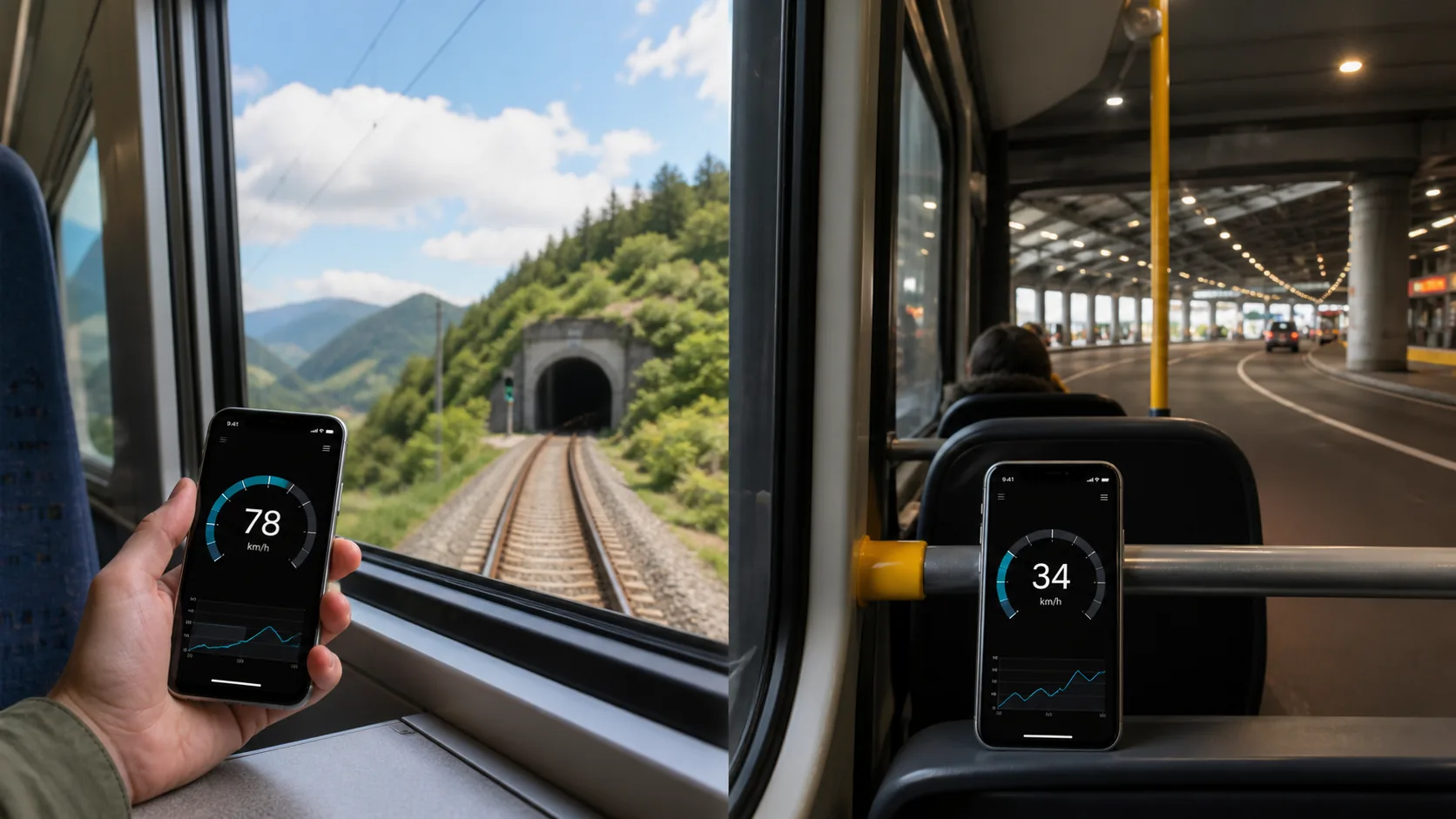
Mark missing intervals instead of inventing a speed
An unchanged display during a tunnel is not a series of new equal-speed observations. A zero accompanied by unavailable location is also different from a fresh measurement while stopped. Note roughly when the gap started, the environment and when useful updates returned. There is no need to publish your precise route to describe the issue. Avoid drawing a straight line across the gap and claiming that it reconstructs every turn, stop or speed inside it.
Calculate averages only with compatible distance and time
For an illustrative complete interval, 18 km in 45 minutes gives 24 km/h, because 45 minutes is 0.75 hours. Including boarding or a transfer changes the question the average answers. More importantly, a distance counter that missed part of the journey should not be paired with full elapsed time and presented as an exact service average. State the session boundaries and any gaps when comparing journeys. A moving-only average requires a defined stopping rule; do not silently substitute it.
Compare evidence before blaming one display
A passenger-information screen, a phone and a timetable need not use the same source or update instant. Check units and whether the values refer to now, an average or a planned service. A high isolated phone peak deserves scrutiny, not automatic dismissal of the onboard instrument. Repeatability in a clear section is more informative than selecting one surprising pair. Without a suitable independent reference, a disagreement identifies a question rather than proving which measurement is correct.
Choose what to do with an incomplete result
For a casual speed check, wait for a fresh sequence in a suitable section and keep the conclusion local to that moment. For a whole-journey record, test a recorder that supports your required interruptions and exports before relying on it. For arrivals and service changes, use current operator information. If reporting a reproducible website problem, provide device, browser, visible message and conditions, omitting private journey details. Different goals require different evidence; more decimal places do not repair missing observations.
| Condition or factor | What it means |
|---|---|
| Permission denied | Resolve browser/site access before testing reception. |
| Train moving, location unavailable | Record a missing interval; do not infer that the train stopped. |
| Low average with many stops | Check elapsed time and boundaries before comparing cruising speeds. |
| Incomplete distance and full-session duration | Describe a partial record, not an exact operator journey average. |
Technical references: W3C: observation timestamps and available coordinates; MDN: visible and background browser pages.
Interpreting public-transport GPS readings
Does this guide provide live tracking of public transport?
No. It explains a phone measurement taken by a passenger. It is not an operator map or a lookup by route or vehicle number.
Can I reconstruct a tunnel from its entry and exit readings?
Those observations do not reveal every speed change or stop inside the tunnel. Any reconstruction needs additional assumptions and should not be presented as measured data.
Why is internet available but speed missing?
Loading network content and obtaining a useful device location are different capabilities. A connection alone does not establish fresh speed.
Should I delete every session containing a gap?
Not necessarily. It may still answer a limited question about a valid segment, provided you disclose the missing interval and avoid whole-trip claims.
What should I include when reporting inconsistent readings?
Device and browser versions, units, whether the page was visible, the displayed status and the conditions of the interruption. A full private route is generally unnecessary.