Boat speed in knots: what GPS, current and the water-speed log tell you
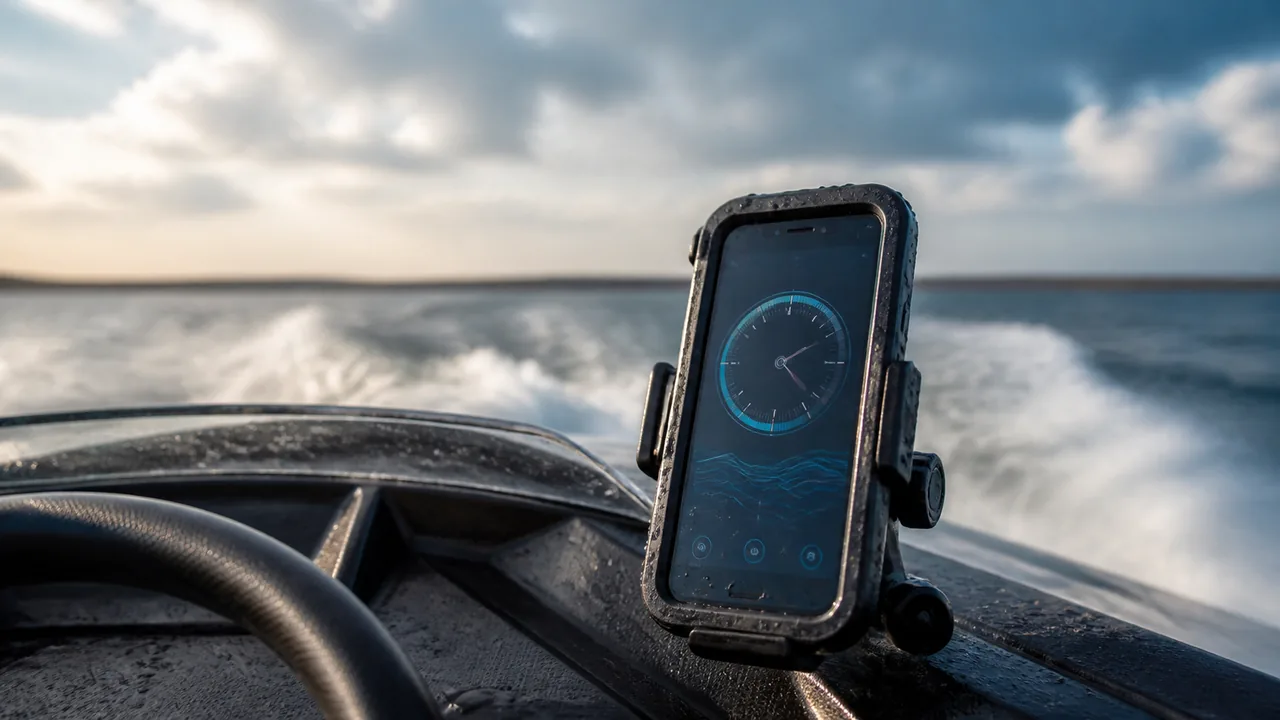
Two instruments can show different boat speeds because they answer different questions. Before judging the larger number as better, identify the unit, the reference and the time interval. This guide connects those three checks so a nautical reading becomes useful information rather than a speed record without context.
Open the live boat speedometer
A knot already contains the hour
A knot is a speed of one nautical mile per hour; the international nautical mile is exactly 1,852 metres. Distance is measured in nautical miles, speed in knots, so “knots per hour” is not the ordinary way to state a boat’s speed. You may encounter kn, kt or kts beside an instrument value. The nautical mile has a historical connection to latitude, but its modern fixed definition is what makes the conversion reliable.
Start with the instrument’s reference, not its appearance
GPS gives an over-ground observation, often labelled SOG. A water-speed log refers to movement through the surrounding water, often labelled STW. A digital display can show either source, so a digital-versus-analogue comparison misses the important distinction. Wind speed is yet another quantity, even if expressed in knots. zigmaty does not read a water-speed transducer or an anemometer and cannot obtain those measurements by switching display modes.
Current explains a difference only with direction included
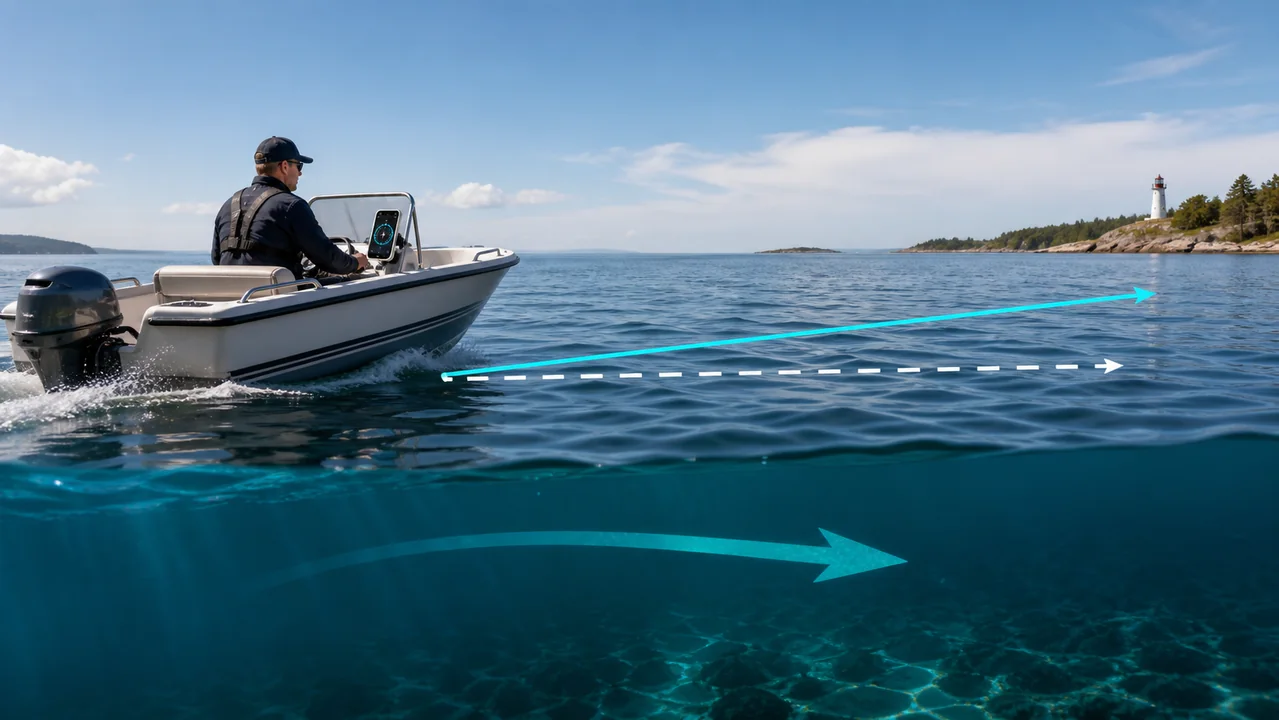
For an intentionally simplified straight-line example, 5 knots through the water plus a directly following 2-knot current gives 7 knots over ground. The same opposing current gives 3. If the flow crosses the boat’s path, both direction and magnitude change; subtracting displayed SOG and STW will not recover the full current vector. Even aligned estimates require comparable, fresh observations. Waves, manoeuvres and different update timing can make a quick screen comparison misleading.
A steady speed is not automatically progress toward the harbour
Nautical units make distance-time arithmetic convenient: an illustrative 9-nautical-mile route at a constant 6 knots over ground takes 1.5 hours. That assumes the whole route is travelled at that rate. A turn, a tack, a changing current or a stop invalidates a simple straight-line prediction. Speed magnitude alone does not say how much of the motion is toward your destination. This article is explaining the arithmetic, not providing a passage plan or live arrival forecast.
Compare like with like before discussing performance
Keep speed reference, unit, segment and conditions with any note. A higher over-ground value on the return leg may reflect current rather than more efficient propulsion or better sail trim. A maximum from one noisy observation is different from a sustained cruising interval. Do not calibrate a water-speed instrument by forcing it to match one phone GPS value. Follow the instrument maker’s procedure and suitable marine practice; this browser is not a calibration reference.
Translate the number without changing what it measures
A hypothetical 12-knot SOG value is 22.224 km/h SOG. Conversion has changed the unit, not removed the current or increased the certainty of the observation. Similarly, converting forecast wind to km/h does not turn it into boat speed or decide whether conditions are safe. Use the calculator for a particular value and the separate chart for repeated lookups. Keep a note of the original quantity when sharing a converted number.
| Condition or factor | What it means |
|---|---|
| kn or knots | Speed unit: nautical miles per hour. |
| SOG | Movement relative to the Earth; typical GPS reference. |
| STW | Movement relative to the surrounding water. |
| Nautical miles | Distance, not speed; combine with time for an average. |
Technical references: NOAA: nautical mile and knot; W3C: device location observations.
Understanding nautical speed readings
Is a knot the same as a mile per hour?
No. A nautical mile is 1.852 km; a statute mile is 1.609344 km. The resulting speed units differ.
Is GPS speed unaffected by current?
GPS does not need a water-speed sensor, but the boat’s resulting motion over ground includes the effect of current.
Can I find current by subtracting STW from SOG?
Not generally. That shortcut needs aligned directions and comparable readings; a cross current requires vector information.
Is there one normal speed for every sailboat?
No. Vessel design, loading, conditions and the chosen speed reference matter. A generic range is not a target to reach.
Does a higher reading mean I will arrive sooner?
Only if it represents useful progress on the actual remaining route under comparable conditions. A present speed alone cannot account for the passage ahead.